
TALON
Hypersonic Missile Detection & Tracking
TALON is JANUS' hypersonic missile detection and tracking capability, designed to run onboard the newest generation of space-based sensors. It finds dim, unresolved targets that conventional processing would miss, locks onto them, and holds that track in real time on the kind of small, power-constrained hardware that actually flies on a satellite. Purpose-built for the proliferated low-Earth-orbit (LEO) future of missile warning, TALON gives constellation and sensor developers a proven, flight-minded detect-and-track capability they do not have to build from scratch.
Engineered for Excellence
Advanced Temporal Anomaly Detection
Rather than looking for a bright object in a single frame, TALON examines how the scene evolves across multiple frames to separate a moving target's signature from the naturally changing background — revealing dim, unresolved targets that wide-field-of-view sensors would otherwise miss.
Unscented Kalman Filter Tracking
Once a target is detected, TALON tracks it with an optimized Unscented Kalman Filter, a mature and well-understood technique for estimating the path of a maneuvering object — maintaining custody as the missile accelerates and maneuvers at Mach 5 and beyond.
Onboard, Real-Time Performance
Built from the start for real-time operation onboard the satellite itself. Implemented for GPU-accelerated, low size, weight, and power (SWaP) edge computing, with key components optimized from Python to C++ to run the full detect-and-track chain at a high update rate.
Built for Proliferated LEO
Purpose-built for the shift from a small number of exquisite satellites to proliferated low-Earth-orbit constellations, where wide-field-of-view sensors dilute even hot, fast-moving hypersonic targets within large pixels.
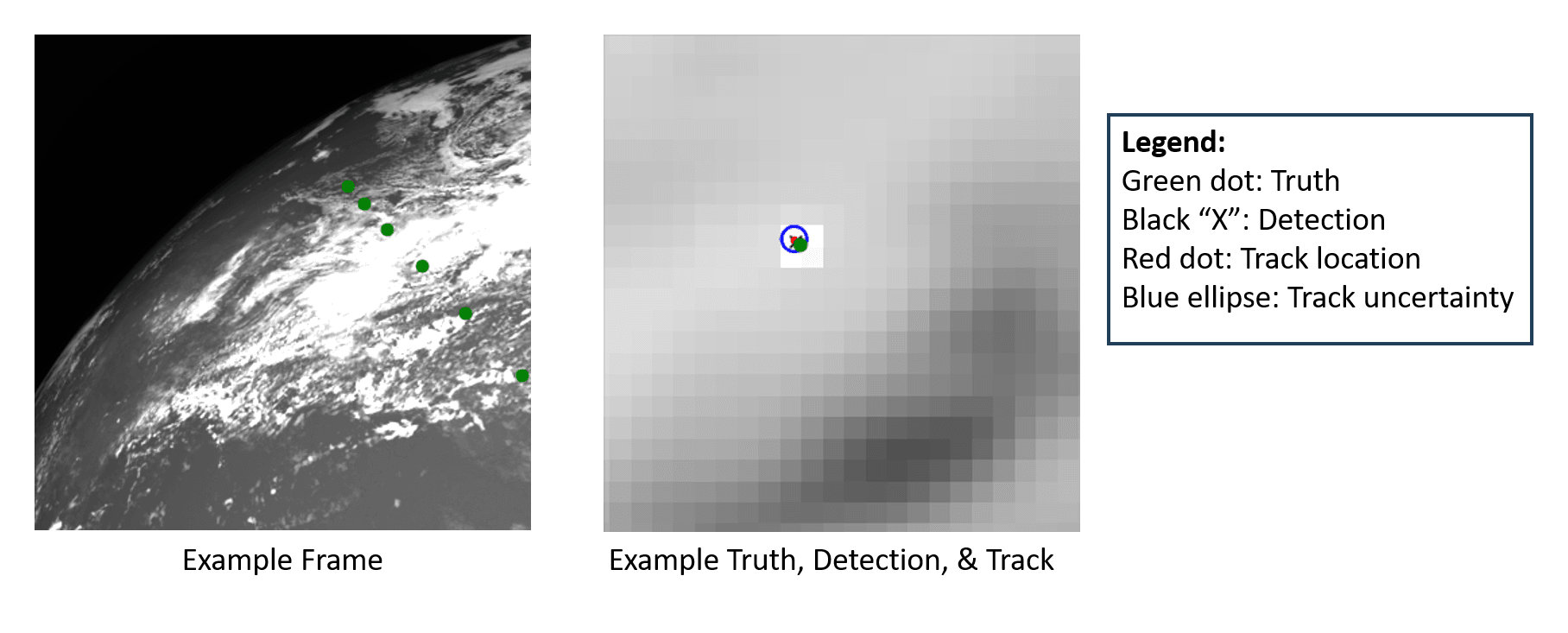
Left: Simulated wide-field-of-view, low-Earth-orbit sensor frame generated with ASSET; the green dots are true locations of simulated hypersonic missile signatures. Right: Zoomed-in view of one of the missile tracks; the green dot is the true location of the simulated missile, the red dot is the track location, the blue ellipse is the track uncertainty, and the black “X” is the detection of the missile from that frame.
Proven Performance
Data-Driven Superiority
Validated with AFIT ASSET
TALON is validated using high-fidelity synthetic data generated with the Air Force Institute of Technology (AFIT) Sensor and Scene Emulation Tool (ASSET), producing realistic frame sequences that incorporate satellite, target, and cloud motion.
Real-Time on Flight-Ready Hardware
TALON has demonstrated real-time detection and tracking on the kind of small, efficient, low-power processors that can realistically fly on a proliferated-LEO satellite — not data-center hardware.
Mach 5+ Target Custody
Detection finds the target; the tracker never lets it go. TALON maintains custody of hypersonic threats through the acceleration and maneuvering that make them so difficult to hold.
Broad Scenario Coverage
Evaluations span specified sensor geometries and characteristics together with a broad range of target and environmental conditions — the kind of variability the system would face in the field.
What We Bring To The Fight
Built to Partner
TALON is the onboard detection-and-tracking "brain" that complements the satellites and sensors built by others — a building block for constellation and sensor developers.
OPIR Heritage Since 2016
Developed by JANUS' overhead persistent infrared (OPIR) team, one of the first tenants of the OPIR TAP Laboratory in Boulder, Colorado, with deep expertise across missile tracking and warning programs.
Purpose-Built Software
New detection and tracking code built for the future generation of space-based sensors — not legacy processing carried over from the previous era of missile warning.
A Broader Sensing Portfolio
TALON stands on its own but shares a research culture with JANUS efforts like RAPTOR, the company's synthetic target-signature generator, reflecting depth across the modern sensing pipeline.