
FloodScan
Satellite Flood Mapping Service
Daily maps of large-scale inland flooding from 1998 to present, using satellite remote sensing at ~90m resolution across continental coverage areas. FloodScan provides algorithmically consistent flood extent data — free of human interpretation bias — supporting humanitarian response, insurance analytics, risk modeling, and government reporting.
Engineered for Excellence
Continental-Scale Coverage
Daily flood extent mapping across three major coverage domains: Africa, the Americas, and Asia-Australia, with coast-to-coast inland flood detection.
Passive Microwave Detection
Uses passive microwave brightness temperatures — primarily in the 37 GHz band — from a cross-calibrated constellation of satellite sensors (SSM/I, TMI, AMSR-E, AMSR2, and GMI), providing flood detection regardless of cloud cover — unlike optical or SAR systems.
Automated Quality Screening
Every observation passes through atmospheric correction plus automated screening for precipitation, frozen surfaces, and false positives before it contributes to a flood depiction — no analyst in the loop.
25+ Year Historical Archive
Continuous daily flood mapping record from 1998 to present, enabling trend analysis, flood frequency studies, and actuarial risk modeling.
Algorithmic Consistency
Fully automated satellite data processing ensures objective, reproducible flood detection results without human interpretation bias or variability.
Spatial Disaggregation
Proprietary algorithms first estimate the flooded fraction of each coarse sensor footprint, then downscale to ~90m (3-arcsecond) flood maps using a relative-floodability model built from high-quality terrain (MERIT DEM) and historical surface water data — providing actionable spatial detail for local decision-making.
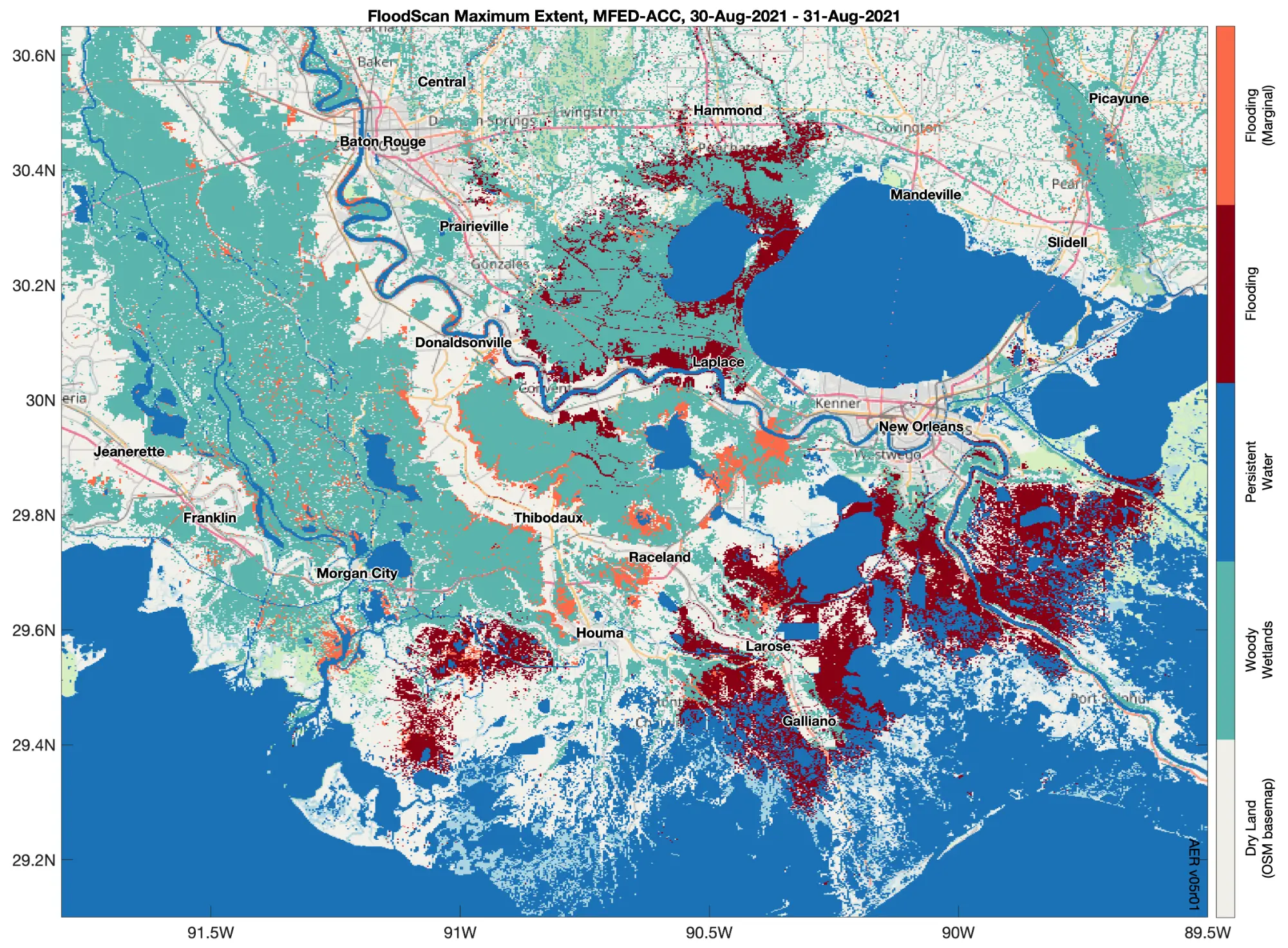
FloodScan maximum flood extent across southeastern Louisiana following Hurricane Ida, 30–31 Aug 2021.
Proven Performance
Data-Driven Superiority
Coverage Resolution
Approximately 90m effective spatial resolution for flood extent mapping through advanced disaggregation techniques.
Update Frequency
Daily updates from multiple polar-orbiting satellite observations, with near real-time processing for rapid event response.
Historical Record
Continuous daily archive from January 1998 to present — over 25 years of consistent flood mapping data.
All-Weather Capability
Passive microwave observations penetrate cloud cover, providing flood detection even during active precipitation events when optical satellites are blinded.
Multi-Sensor Continuity
Observations from five sensor generations — SSM/I, TMI, AMSR-E, AMSR2, and GMI — are cross-calibrated to a common reference, so the multi-decadal record remains consistent as satellites are retired and replaced.
Independently Validated
Algorithm performance is assessed against flood extent maps independently derived from high-resolution optical imagery (MODIS, Landsat) for well-documented major flood events — see the algorithm performance document below.
What We Bring To The Fight
Humanitarian Response
Real-time flood extent mapping enables rapid situational awareness for disaster relief organizations and emergency management agencies.
Insurance & Reinsurance
Objective, timestamped flood extent data supports claims adjustment, catastrophe modeling, and actuarial analysis for the insurance industry.
Risk Analytics
Multi-decadal flood frequency analysis and trend detection for financial modeling, infrastructure planning, and adaptation strategies.
Government Reporting
Consistent methodology for national and international flood loss databases, supporting regulatory compliance and policy development.
Technical Documentation
Detailed algorithm documentation for FloodScan is available for download.
ARC Flood Extent Depiction Algorithm Description Document
The complete theoretical basis for FloodScan's flood extent depiction algorithm (AFED v05r00): sensor inputs, flooded-fraction estimation, quality screening, and the ~90m downscaling process.
PDF · 4.1 MB
ARC Flood Extent Depiction Algorithm Performance Document
Validation of the flood extent depiction algorithm against flood maps independently derived from high-resolution optical imagery for well-documented major flood events.
PDF · 30 MB